Dear Sign Lady,
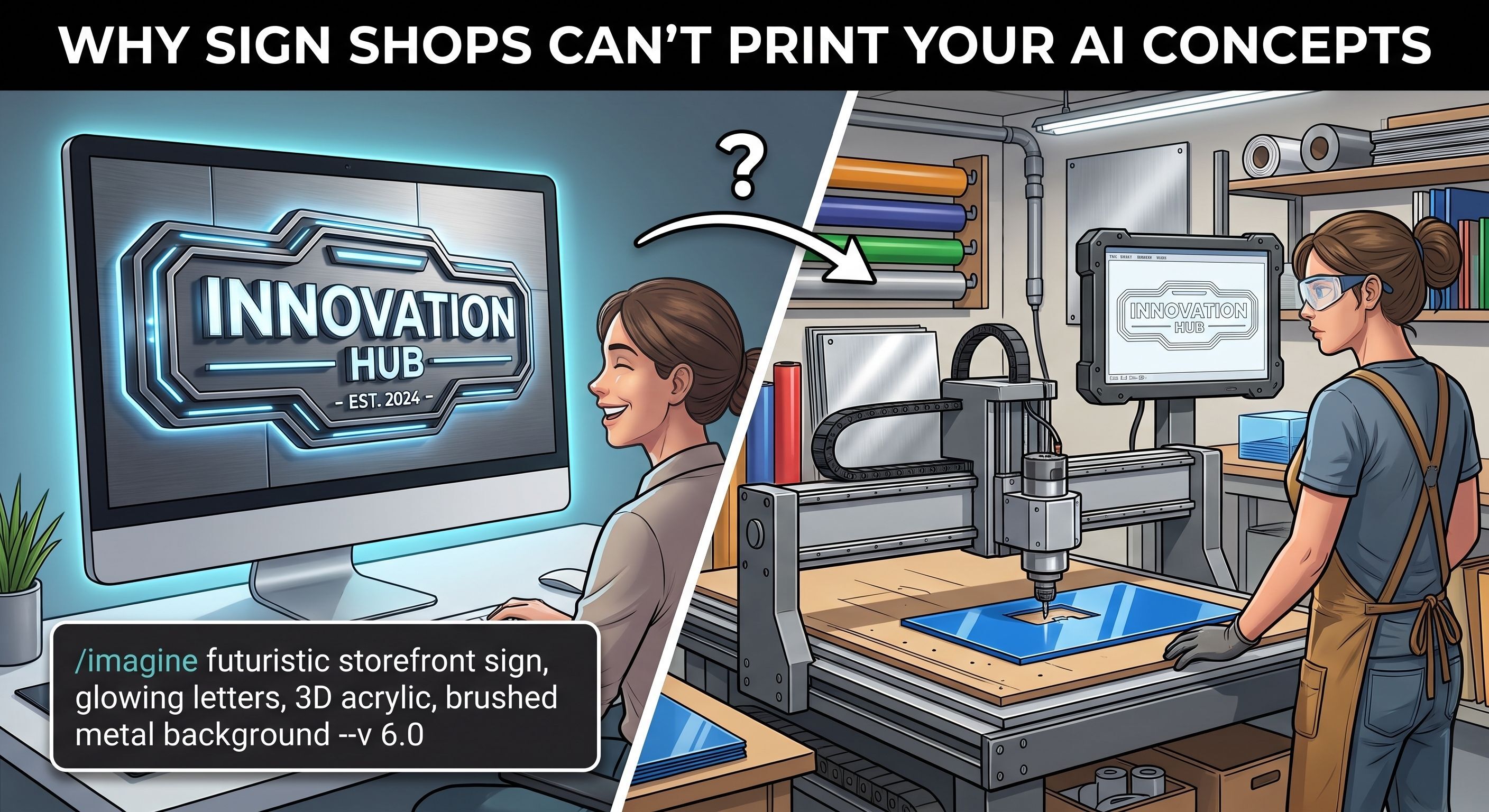
I spent hours coaxing the absolute perfect storefront layout out of an AI image generator. It looks stunning on my screen! But when I emailed the image to my local sign shop, they said they couldn't use it directly and want to charge me a fee to redraw it as a vector file. Why can’t they just use the image I sent them?
— Prompting in Pedro
Dear Prompting,
I hear your frustration! You spent real time dialing in your vision, and having a sign maker tell you it isn't "usable" feels like bumping into a brick wall. AI is an incredible tool for brainstorming, but there is a very real, technical reason your shop is hitting the brakes.
AI tools generate brilliant concept art, but sign shops build physical objects. Here is why your AI file needs a translation before it hits the shop floor:
- Pixels vs. Math (Raster vs. Vector): AI exports images as JPEGs or PNGs—flat grids of tiny colored squares (pixels). If you stretch a small image across an eight-foot storefront sign, those pixels turn into giant, blurry blocks. Sign shops require vector files (formats like .AI, .EPS, or .SVG), which use mathematical equations to define lines and curves so your artwork stays crisp at any size.
- Machinery Speaks Vector: If your sign features cut vinyl, dimensional acrylic letters, or routed wood, a machine like a CNC router or laser cutter has to shape it. A cutter blade cannot read a JPEG pixel grid; it needs vector paths to guide the physical tool.
- Screen Light vs. Physical Paint: AI renders images in RGB (red, green, blue light) meant for glowing screens. Physical signage relies on ink (CMYK) or physical paint matching systems (Pantone). That vivid, glowing shade on your phone screen will look very different when translated into real-world ink on aluminum.
- AI Ignores Physics: AI doesn't account for LED wiring, mounting hardware, material thickness, or structural seams. It creates a visual surface, not an engineering schematic.
The Verdict
Think of your AI creation as an architect’s artistic sketch: it’s an amazing visual target, but you still need structural blueprints before you can lay foundation. Paying the shop’s vectorization or file-prep fee turns your digital inspiration into a tangible, durable reality.
Permitting
Exterior signage almost always requires a permit. Your sign contractor will need to submit drawings with the paperwork for the permit.
Final Thoughts
Send us your AI artwork today for a quick file-prep audit and reality check of what AI "thinks" can be made.
